
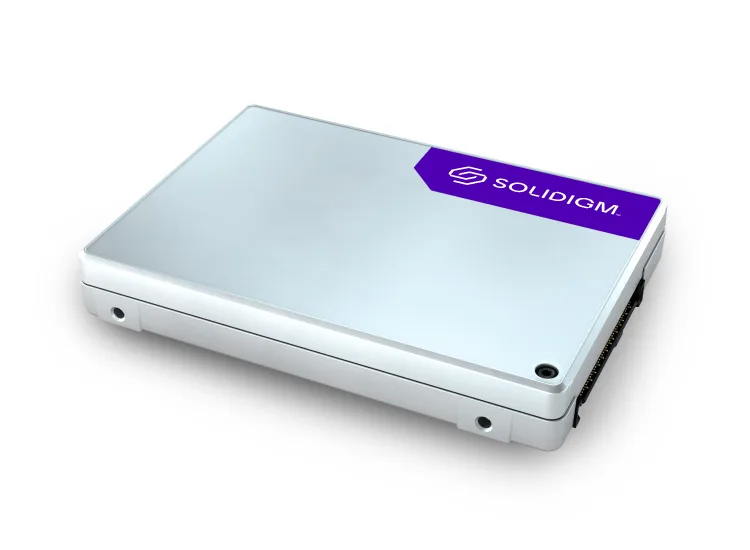
Brand: Solidigm | Category: Enterprise SSDs
SKU: SSDPF2KX076TZ02 | Part #: SSDPF2KX076TZ02 | MPN: SSDPF2KX076TZ02
Contact for Pricing — Request a Quote
The Solidigm P5530 Enterprise SSD (SSDPF2KX076TZ02) at 7.68TB capacity carries a 1 DWPD endurance rating—a specification that matters most when you're fielding write-heavy analytics clusters, transactional databases, or cache-tier deployments. One drive-write-per-day endurance translates to genuine longevity in environments where daily data churn measures in terabytes, not gigabytes. Storage architects and infrastructure teams evaluating this 7.68TB model need to understand that endurance isn't academic; it directly impacts total cost of ownership across three to five-year replacement cycles.
Built on Solidigm's 144-layer QLC NAND architecture, the P5530 series occupies a specific niche in the enterprise storage hierarchy. QLC technology packs four bits per cell, which is why capacity-per-dollar improves compared to TLC alternatives, but endurance and performance sit slightly lower on the performance curve. The SSDPF2KX076TZ02 delivers sequential reads at 7,000 MB/s and sequential writes at 3,600 MB/s—figures that satisfy most server-attached and SAN-adjacent workloads without the premium attached to higher-performance tiers. Random read throughput reaches 1,500,000 IOPS at 4K block size, while random write performance plateaus at 270,000 IOPS. For infrastructure teams managing mixed read-write patterns typical of ERP systems, customer databases, and content distribution hubs, these numbers provide a realistic baseline.
The drive interfaces via PCIe 4.0 x4 with NVMe 1.4 protocol support, arriving in standard U.2 form factor (SFF-8639 connector) with 15mm height. Data centre engineers appreciate that U.2 connectivity remains platform-agnostic across Dell, HPE, and Lenovo server lineups, simplifying procurement and deployment. Solidigm included power loss protection as standard, which prevents mid-write corruption during unexpected shutdown—a non-negotiable feature in enterprise environments. Encryption arrives via AES 256-bit with TCG Opal 2.0 support, satisfying compliance officers concerned with FIPS 140-2 or industry-specific data residency mandates. End-to-end data protection through T10 DIF/DIX adds another layer of confidence for mission-critical storage tiers. The SSDPF2KX076TZ02 remains accessible to NVMe Management Interface (NVMe-MI) tooling, enabling remote health monitoring and firmware updates without server downtime.
Deployment scenarios for this Solidigm P5530 7.68TB model cluster around mid-market and large enterprise data centres seeking capacity expansion without architectural redesign. When a storage team needs to refresh a SAN tier or add capacity to an existing NVMe shelf, the 7.68TB capacity density combined with reasonable endurance characteristics makes the business case simple. AI infrastructure teams training large language models benefit from the sequential read speed for batch data loading, while the modest random write ceiling means they'll continue to layer NVMe-optimized software (like distributed cache or memory-mapped file systems) on top. Financial services firms running nightly batch reconciliation processes, healthcare networks managing DICOM image archives, and manufacturing operations storing sensor telemetry all represent realistic customer profiles for SSDPF2KX076TZ02 deployments. The part number itself—SSDPF2KX076TZ02—has become familiar shorthand among procurement specialists across the GCC region who spec storage refreshes in the 7–10TB capacity bracket.
Operating temperature specifications (0°C to 70°C) confirm this drive is built for standard data centre environments, not exotic cooling regimens. The absence of heatsinks or exotic thermal interface materials keeps installation straightforward and cost per watt reasonable. Storage architects will find the P5530 series occupies less power budget than comparable enterprise NVMe drives, which matters when thermal density or power delivery becomes a constraint in fully-subscribed chassis. Endurance aside, the combination of reasonable performance, standardized form factor, and basic enterprise features (encryption, power loss protection, data protection) explains why the SSDPF2KX076TZ02 appears in refresh specifications across financial, logistics, and government sectors throughout the region.
At Omnixon Global, we supply the Solidigm P5530 Enterprise SSD (SSDPF2KX076TZ02) and comparable storage solutions to data centre operators, system integrators, and enterprise procurement teams throughout the UAE, GCC, and into Asia and Europe. Whether you're planning a storage refresh, scaling an existing NVMe tier, or building out new infrastructure for analytics or content delivery, our team understands the operational and budgetary constraints that drive real-world storage decisions. We maintain stock visibility across multiple regions and manage lead times with transparency. For current availability, configuration options, or technical consultation on whether the P5530 7.68TB model fits your architecture, please submit an RFQ through our sales portal or contact our enterprise storage specialists directly.
| Brand | Solidigm |
| Category | Enterprise SSDs |
| SKU | SSDPF2KX076TZ02 |
| Part Number | SSDPF2KX076TZ02 |
| Condition | New |
| Capacity | 7.68TB |
| Form Factor | U.2 |
| Interface | PCIe Gen5 |
| Speed | Read: 12,000 MB/s, Write: 11,000 MB/s |
| Manufacturer Part Number | SSDPF2KX076TZ02 |
| Series | P5530 |
| Raw Capacity | 7.68 TB |
| Form Factor | U.2 15mm (2.5-inch) |
| Interface | PCIe 4.0 x4 |
| Protocol | NVMe 1.4 |
| NAND Technology | 144-layer QLC (Quad-Level Cell) |
| Sequential Read (Max) | 7,000 MB/s |
| Sequential Write (Max) | 3,600 MB/s |
| Random Read (4K, Max) | 1,500,000 IOPS |
| Random Write (4K, Max) | 270,000 IOPS |
| Endurance (DWPD) | 1 DWPD |
| Power Loss Protection | Yes |
| Encryption | AES 256-bit (TCG Opal 2.0) |
| End-to-End Data Protection | Yes (T10 DIF/DIX) |
| Management Interface | NVMe-MI |
| Operating Temperature | 0°C to 70°C |
| Connector | SFF-8639 (U.2) |
At 7.68TB, the Solidigm P5530 Enterprise SSD (Expected) - 7.68TB suits enterprise data-center storage tiers — all-flash arrays, hyperconverged storage pools (vSAN, Ceph), database backends, and high-throughput backup repositories. The PCIe 5.0 x4 interface is supported by major server platforms.
Key specifications for the Solidigm P5530 Enterprise SSD (Expected) - 7.68TB: capacity 7.68TB; form factor U.2 (15mm); interface PCIe 5.0 x4; new condition; drive media type SSD; storage form factor U.2 (15mm); storage capacity 7.68TB; storage interface PCIe 5.0 x4. Manufacturer part number SSDPF2KX076TZ02. For the full datasheet with electrical, environmental, and compliance details, contact our pre-sales engineering team.
The Solidigm P5530 Enterprise SSD (Expected) - 7.68TB uses a PCIe 5.0 x4 interface in a U.2 (15mm) form factor. It's compatible with server platforms that expose this interface — typical deployments include Dell PowerEdge, HPE ProLiant, Lenovo ThinkSystem, and Supermicro SuperServer chassis. For specific vendor part-number compatibility, our team validates against the manufacturer support matrix.