
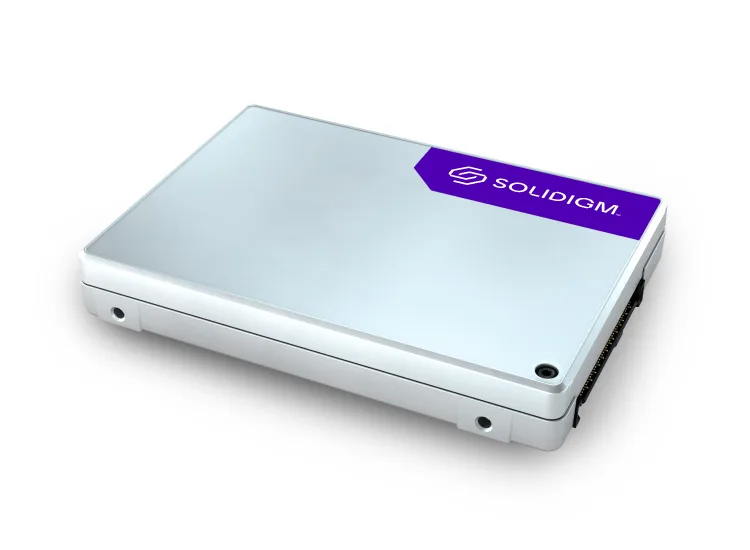
Brand: Solidigm | Category: Enterprise SSDs
SKU: SSDPF2KE061TZ02 | Part #: SSDPF2KE061TZ02 | MPN: SSDPF2KE061TZ02
Contact for Pricing — Request a Quote
At 61.44TB capacity in the compact E1.L ruler form factor, the Solidigm P5336 QLC Enterprise SSD (SSDPF2KE061TZ02) occupies a specific and well-defined role in modern data-centre architecture: read-intensive caching and reference-data acceleration. With random read performance reaching 1.5 million IOPS, this drive is engineered to serve as a performance tier for workloads where read throughput matters far more than write velocity. Storage architects and infrastructure teams deploying large-scale analytics platforms, machine learning inference clusters, or data-warehouse systems increasingly specify QLC-based enterprise SSDs like the P5336 for the read cache layer, where the cost-per-terabyte advantage offsets the lower write performance compared to TLC or SLC alternatives.
The Solidigm P5336 uses QLC NAND technology—four bits of data stored per cell—which directly enables the massive 61.44TB capacity in a single drive. This density matters when you're designing storage for petabyte-scale deployments across multiple data centres in the GCC region or beyond. The SSDPF2KE061TZ02 connects via PCIe Gen 4 x4 and NVMe, delivering sequential reads up to 7,000 MB/s and sequential writes up to 3,000 MB/s. For read-heavy workloads—think reference tables in financial analytics, model weights in AI inference, or archive indexing—these throughput figures are sufficient and combined with the 1.5M read IOPS, they position the drive as a cost-effective performance accelerator rather than a primary transactional store.
Endurance and operational reliability reflect Solidigm's enterprise-grade positioning. The P5336 is rated for 2,500 TBW (terabytes written) over its lifespan, translating to 0.058 DWPD (drive writes per day) when calculated across a five-year window. This conservative write endurance is appropriate for read-intensive deployments; in workloads where 80–90% of operations are reads, the actual operational life of the drive typically extends well beyond manufacturer projections. Power consumption remains modest at up to 25W under active load, a consideration that compounds across hundreds of drives in a hyperscale facility. Solidigm rates the mean time between failures at 2,000,000 hours, and the drive operates across the standard enterprise temperature range of 0°C to 70°C, making it suitable for both climate-controlled data-centre racks and edge deployment scenarios common in the Middle East and South Asian markets.
Security is integral to the P5336 specification. The SSDPF2KE061TZ02 includes AES 256-bit full-disk encryption and implements TCG Opal 2.0 compliance, allowing storage administrators and security teams to enforce encryption at rest without reliance on host-based solutions. This is particularly important in regulated industries—banking, healthcare, government—where data residency and encryption verification are audit requirements. For teams managing multi-tenant or shared storage environments, the self-encrypting drive capability simplifies compliance workflows and reduces the computational overhead that software-based encryption introduces to the host system.
The E1.L form factor—the Solidigm nomenclature for EDSFF Ruler drives—is not incidental to the P5336's value proposition. Ruler drives pack significantly higher density per rack unit than 2.5-inch or 3.5-inch form factors, allowing infrastructure teams to build larger capacity pools in the same physical footprint. When a storage architect is planning a 500TB to 1PB read cache cluster for a machine-learning platform or a data-warehouse acceleration tier, the ability to deploy 16 or 32 TB drives in a single 1U or 2U appliance fundamentally changes the economics and operational simplicity of the design. Omnixon Global routinely works with systems integrators and enterprise procurement teams across the UAE, Saudi Arabia, and India who are transitioning from SAS SSD platforms to NVMe-based solutions like the P5336, and the ruler form factor is often the deciding factor in those architecture reviews.
Omnixon Global stocks and distributes the Solidigm P5336 QLC Enterprise SSD across the GCC, South Asia, and into Europe, serving hyperscalers, system integrators, and enterprise IT teams building the next generation of data-centre infrastructure. If your organisation is evaluating dense, cost-effective read-cache solutions for analytics platforms, AI inference clusters, or cloud-storage acceleration, we invite you to submit an RFQ for the SSDPF2KE061TZ02 or discuss your specific architectural requirements with our technical team in Dubai. Contact us to explore availability, configuration options, and how Solidigm enterprise SSDs can integrate into your storage roadmap.
| Brand | Solidigm |
| Category | Enterprise SSDs |
| SKU | SSDPF2KE061TZ02 |
| Part Number | SSDPF2KE061TZ02 |
| Condition | New |
| Capacity | 61.44TB |
| Form Factor | E1.L |
| Interface | PCIe Gen5 |
| Speed | Read: 12,000 MB/s, Write: 5,000 MB/s |
| Product Family | P5336 |
| Manufacturer Part Number | SSDPF2KE061TZ02 |
| Capacity | 61.44TB |
| Form Factor | E1.L (EDSFF Ruler) |
| Interface | PCIe Gen 4 x4, NVMe |
| NAND Technology | QLC (4-bit per cell) NAND |
| Sequential Read | Up to 7,000 MB/s |
| Sequential Write | Up to 3,000 MB/s |
| Random Read (4K) | Up to 1,500,000 IOPS |
| Random Write (4K) | Up to 200,000 IOPS |
| Power Consumption (Active) | Up to 25W |
| Endurance (TBW) | 2,500 TBW |
| DWPD | 0.058 DWPD (5-year) |
| Encryption | AES 256-bit Self-Encrypting Drive (SED), TCG Opal 2.0 |
| Operating Temperature | 0°C to 70°C |
| Mean Time Between Failures (MTBF) | 2,000,000 hours |
| Workload Profile | Read Intensive |
At 61.44TB, the Solidigm P5336 QLC Enterprise SSD (Expected) - 61.44TB suits enterprise data-center storage tiers — all-flash arrays, hyperconverged storage pools (vSAN, Ceph), database backends, and high-throughput backup repositories. The PCIe 5.0 x4 interface is supported by major server platforms.
Key specifications for the Solidigm P5336 QLC Enterprise SSD (Expected) - 61.44TB: capacity 61.44TB; form factor E1.L; interface PCIe 5.0 x4; new condition; drive media type SSD; storage form factor E1.L; storage capacity 61.44TB; storage interface PCIe 5.0 x4. Manufacturer part number SSDPF2KE061TZ02. For the full datasheet with electrical, environmental, and compliance details, contact our pre-sales engineering team.
The Solidigm P5336 QLC Enterprise SSD (Expected) - 61.44TB uses a PCIe 5.0 x4 interface in a E1.L form factor. It's compatible with server platforms that expose this interface — typical deployments include Dell PowerEdge, HPE ProLiant, Lenovo ThinkSystem, and Supermicro SuperServer chassis. For specific vendor part-number compatibility, our team validates against the manufacturer support matrix.