
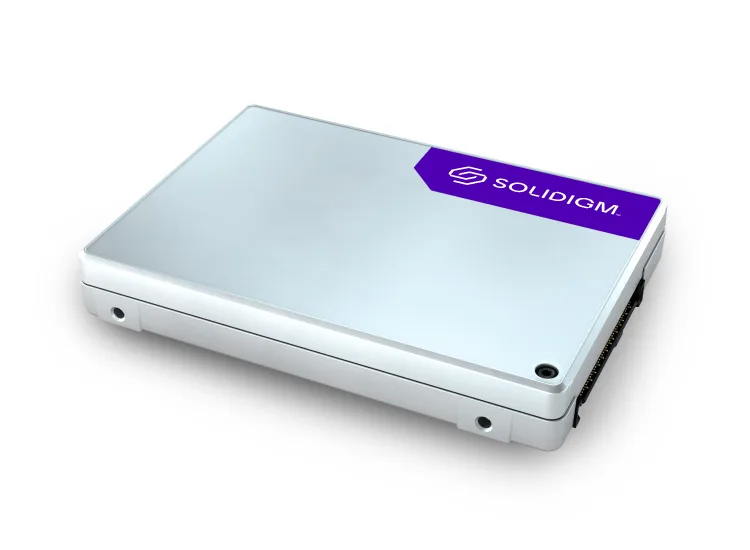
Brand: Solidigm | Category: Enterprise SSDs
SKU: SSDPF2KE031TZ02 | Part #: SSDPF2KE031TZ02 | MPN: SSDPF2KE031TZ02
Contact for Pricing — Request a Quote
The Solidigm P5336 QLC Enterprise SSD arrives in the E1.L form factor—a long, 9.5mm tall module that slots into EDSFF (Enterprise SSD Form Factor) bays found in modern data-centre server backplanes. Unlike traditional M.2 drives or 2.5-inch U.3 form factors, the E1.L design maximizes density within a single server chassis, allowing storage architects to provision 30.72TB of capacity in a single bay without sacrificing CPU or memory slots. This matters because in dense compute environments—whether AI inference clusters, vector databases, or large-scale analytics platforms—every millimetre of physical real estate translates to operational efficiency and cost-per-terabyte economics.
Raw throughput on the SSDPF2KE031TZ02 sits at 7,000 MB/s sequential read and 3,200 MB/s sequential write across a PCIe Gen 4 x4 NVMe 1.4 interface. Those numbers reflect the trade-offs inherent in QLC (Quad-Level Cell) technology: Solidigm has squeezed four bits of data into each cell using 144 layers of 3D NAND, prioritizing capacity density over absolute speed. For random workloads, the P5336 sustains up to 1.5 million IOPS on 4K reads and 200,000 IOPS on writes—credentials that suit warm-tier data lakes and archival systems far more than transactional OLTP. Storage architects and infrastructure teams evaluating the SSDPF2KE031TZ02 typically plot its performance against their queue-depth profiles; at high queue depths, NVMe parallelism keeps throughput steady, but shallow-queue, single-threaded access patterns will reveal the ceiling imposed by QLC overhead.
Endurance on this Solidigm drive comes in at 0.58 DWPD (drive writes per day) across a five-year warranty, translating to 32,480 TBW (terabytes written). That modest write budget is the expected trade-off for QLC's cost advantage—if your workload is write-heavy or requires frequent retraining of large language models, you should model the replacement cycle accordingly. The drive draws 18W under active load and 8W idle, making it respectable for data-centre power accounting, particularly when multiplied across racks. Operating temperature range extends from 0°C to 70°C, and the 120-microsecond typical sequential read latency positions this SSD firmly in the bulk-storage camp rather than ultra-low-latency premium tier. Security is handled through AES-256 self-encrypting drive functionality and TCG Opal 2.0 compliance, satisfying regulatory mandates in financial services, healthcare, and government sectors across the GCC and Asia-Pacific regions.
The P5336's 110 × 38.4 × 9.5 mm footprint demands server platforms explicitly designed for E1.L bays—notably the latest generation of 2U and 4U hyperscale rackmount designs from OEM partners. This is not a backward-compatible upgrade path; you are committing to infrastructure that supports this form factor natively. That constraint actually works in favour of storage architects planning greenfield deployments: the E1.L standard is emerging as the industry convergence point for ultra-high-capacity enterprise SSDs, and standardizing your procurement now insulates you from future form-factor fragmentation. Solidigm's NVMe-MI, SMART, and extended log-page support ensure that your out-of-band monitoring and alerting pipelines will integrate seamlessly, which matters when you are managing hundreds of these drives at scale.
Omnixon Global stocks and distributes the Solidigm P5336 throughout the UAE, GCC, and into South Asia and Europe. Whether you are architecting a new AI inference cluster in Dubai, expanding a data-centre footprint in Saudi Arabia, or sourcing bulk enterprise SSD capacity across multiple regions, we handle logistics, validation, and technical support for the SSDPF2KE031TZ02 and complementary infrastructure. Contact our enterprise solutions team to discuss your capacity roadmap, pricing tiers for volume orders, and integration timelines.
| Brand | Solidigm |
| Category | Enterprise SSDs |
| SKU | SSDPF2KE031TZ02 |
| Part Number | SSDPF2KE031TZ02 |
| Condition | New |
| Capacity | 30.72TB |
| Form Factor | E1.L |
| Interface | PCIe Gen5 |
| Speed | Read: 12,000 MB/s, Write: 5,000 MB/s |
| Manufacturer Part Number | SSDPF2KE031TZ02 |
| Model | P5336 |
| Capacity | 30.72 TB |
| Form Factor | E1.L (EDSFF Long, 9.5mm) |
| Interface | PCIe Gen 4 x4, NVMe 1.4 |
| NAND Technology | QLC (Quad-Level Cell) 3D NAND |
| NAND Layers | 144-Layer |
| Sequential Read | 7,000 MB/s |
| Sequential Write | 3,200 MB/s |
| Random Read (4K) | Up to 1,500,000 IOPS |
| Random Write (4K) | Up to 200,000 IOPS |
| Endurance (DWPD) | 0.58 DWPD (5-year) |
| Endurance (TBW) | 32,480 TBW |
| Power (Active, Typical) | 18 W |
| Power (Idle) | 8 W |
| Operating Temperature | 0°C to 70°C |
| Latency (Sequential Read) | 120 µs typical |
| Security | AES-256 Self-Encrypting Drive (SED), TCG Opal 2.0 |
| Dimensions (L × W × H) | 110 mm × 38.4 mm × 9.5 mm |
| Management | NVMe-MI, SMART, Log Page support |
At 30.72TB, the Solidigm P5336 QLC Enterprise SSD (Expected) - 30.72TB suits enterprise data-center storage tiers — all-flash arrays, hyperconverged storage pools (vSAN, Ceph), database backends, and high-throughput backup repositories. The PCIe 5.0 x4 interface is supported by major server platforms.
Key specifications for the Solidigm P5336 QLC Enterprise SSD (Expected) - 30.72TB: capacity 30.72TB; form factor E1.L; interface PCIe 5.0 x4; new condition; drive media type SSD; storage form factor E1.L; storage capacity 30.72TB; storage interface PCIe 5.0 x4. Manufacturer part number SSDPF2KE031TZ02. For the full datasheet with electrical, environmental, and compliance details, contact our pre-sales engineering team.
The Solidigm P5336 QLC Enterprise SSD (Expected) - 30.72TB uses a PCIe 5.0 x4 interface in a E1.L form factor. It's compatible with server platforms that expose this interface — typical deployments include Dell PowerEdge, HPE ProLiant, Lenovo ThinkSystem, and Supermicro SuperServer chassis. For specific vendor part-number compatibility, our team validates against the manufacturer support matrix.