
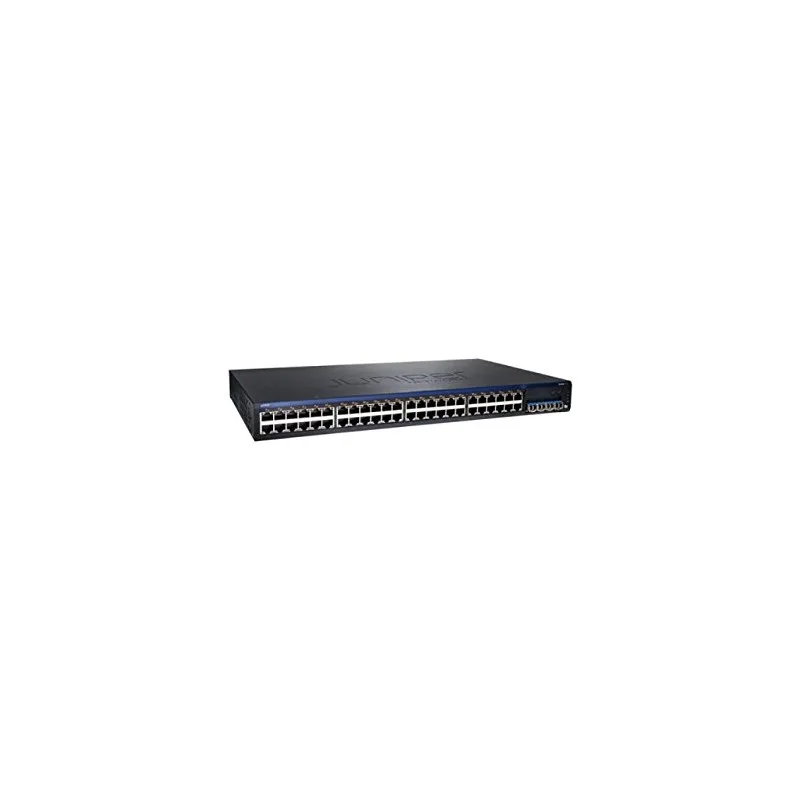
Brand: Juniper | Category: Network Switches
SKU: JUN-QFX5120-001 | Part #: QFX5120-48Y | MPN: QFX5120-48Y
Contact for Pricing — Request a Quote
The QFX5120-48Y from Juniper sits at an inflection point in modern data-centre networking. It operates as a pure Layer 2 switch by default, running Junos OS with straightforward VLAN and 802.1X security controls, but gains Layer 3 routing capability when configured—and critically, this model supports VXLAN and EVPN, making it viable as a leaf or spine fabric member in overlay networks. That control-plane flexibility matters enormously when deciding whether a switch anchors a traditional three-tier architecture or participates in a disaggregated fabric. The distinction shapes purchasing decisions for network engineers evaluating whether they need static, domain-based segmentation or the kind of dynamic, application-aware tenancy that modern cloud and AI workloads demand.
At the port level, the QFX5120-48Y delivers 48 × 25GbE SFP28 interfaces paired with 2 × 100GbE QSFP28 uplinks, yielding a total switching fabric capacity of 1.44 Tbps. The mathematics are deliberate: 48 ports at 25 Gbps equals 1.2 Tbps of edge bandwidth, and the dual 100 Gbps uplinks add another 200 Gbps of spine or aggregation connectivity, all within a single 1U or 2U rackmount form factor depending on configuration. For data-centre operations teams running hyperscale workloads—whether AI training clusters, distributed databases, or microsegmented enterprise networks—that density-to-throughput ratio has real consequences. A network architect designing a leaf-spine topology in a constrained rack footprint often sizes around the QFX5120-48Y because the port-count-to-power-budget tradeoff is mature and proven across thousands of deployments.
Juniper equipped the QFX5120-48Y with redundant, hot-swappable power supplies and cooling fans, a design assumption built into any switch intended for critical-path deployments. There is no scenario in which a single-fan or single-PSU failure triggers an outage; both systems are active-active or active-standby depending on configuration, and both can be pulled and replaced under load. The switching fabric itself is modular, meaning line-card or forwarding-engine upgrades can extend the platform's life as port-speed expectations climb. Junos OS management remains consistent across the Juniper switching portfolio, lowering operational friction for teams that already run QFX or EX platforms elsewhere in the network. Warranty terms are vendor-specific and typically lifetime for hardware components, though support SKUs and maintenance agreements vary by region and purchase channel.
The suite of network security controls—ACL, 802.1X, and VLAN—provides the granular isolation that enterprise and data-centre operators have come to expect. VLAN support enables traditional VLAN-based segmentation for compliance or regulatory boundaries, while 802.1X can enforce port-level authentication when integrated with your authentication backend. ACLs allow stateless filtering by protocol, source, destination, and port, a foundational necessity for any network that must enforce microsegmentation or prevent lateral movement. In environments where VXLAN or EVPN underlay these controls, the QFX5120-48Y acts as the forwarding plane, delegating policy decision and state to a controller or route reflector. This separation of control and data planes is now standard in modern fabrics, and Juniper's implementation is stable and well-documented.
For large-scale deployments—data-centre expansion, AI infrastructure buildout, or enterprise campus consolidation—the decision to standardize on Juniper switches like the QFX5120-48Y typically rests with the network engineering team or principal architect, often in close collaboration with infrastructure or cloud operations leadership. These buyers evaluate not just raw throughput, but operational consistency, sparing strategy, and long-term support roadmap. The QFX5120-48Y has been in production long enough that spares are readily available, configuration examples abound in community forums and vendor documentation, and team familiarity is high. Organisations migrating from older Juniper QFX or competitive platforms often choose the QFX5120-48Y as a drop-in refresh that maintains software compatibility while extending port density and uplink bandwidth.
Omnixon Global maintains an active QFX5120-48Y inventory across our Dubai headquarters and regional service hubs. Whether you are provisioning a new data-centre corridor, refreshing aging fabric in an AI laboratory, or consolidating switching infrastructure across multiple GCC sites, we provide full technical pre-sales support, logistics co-ordination, and post-deployment validation. Our team works directly with your network engineering and procurement stakeholders to align part specification with your fabric topology and operational timeline. If you are evaluating the QFX5120-48Y for immediate or planned deployment, we invite you to submit a detailed RFQ—include your port density, uplink capacity, and expected order timeline so we can confirm availability and discuss commercial terms tailored to your organisation's scale and geography.
| Brand | Juniper |
| Category | Network Switches |
| SKU | JUN-QFX5120-001 |
| Part Number | QFX5120-48Y |
| Condition | New |
| Form Factor | 1RU |
| Interface | 25GbE |
| Switch Series | QFX5120 |
| Rack Units | 1U or 2U (model-dependent) |
| Fans / PSU | Redundant hot-swap |
| Warranty | Lifetime hardware warranty (vendor-specific terms) |
| Manufacturer Part Number | QFX5120-48Y |
| Form Factor | Rackmount |
| Port Count | 48 x 25GbE SFP28 |
| Uplink Ports | 2 x 100GbE QSFP28 |
| Throughput | 1.44 Tbps |
| Switching Fabric | Modular |
| Power Supply | Redundant hot-swap |
| Cooling | Redundant hot-swap fans |
| Management | Junos OS |
| Security Features | ACL, 802.1X, VLAN |
Most enterprise switches ship without transceivers; we quote vendor-matched optics alongside the switch (Cisco-genuine for Catalyst/Nexus, HPE/Aruba-genuine for CX, Juniper-genuine for QFX/EX). Third-party MSA-compatible options are also available at lower cost — specify preference in the RFQ.
Yes — our network engineers can pre-stage stacking, VPC pairs, MLAG, EVPN-VXLAN, or fabric extender configurations before shipping, or provide remote commissioning. Add commissioning to your RFQ.
Switch software licensing varies by vendor. Cisco DNA / Cisco DCNM, Aruba CX licensing tiers, Juniper Premium, NVIDIA Cumulus — we quote the licensing tier matched to your features (BGP-EVPN, telemetry, automation). No surprises at delivery.
Yes — manufacturer hardware warranty is global (return-to-vendor or advance replacement depending on tier). For 24x7 same-day on-site replacement, attach a SmartNet / Foundation Care / J-Care contract during quoting.