
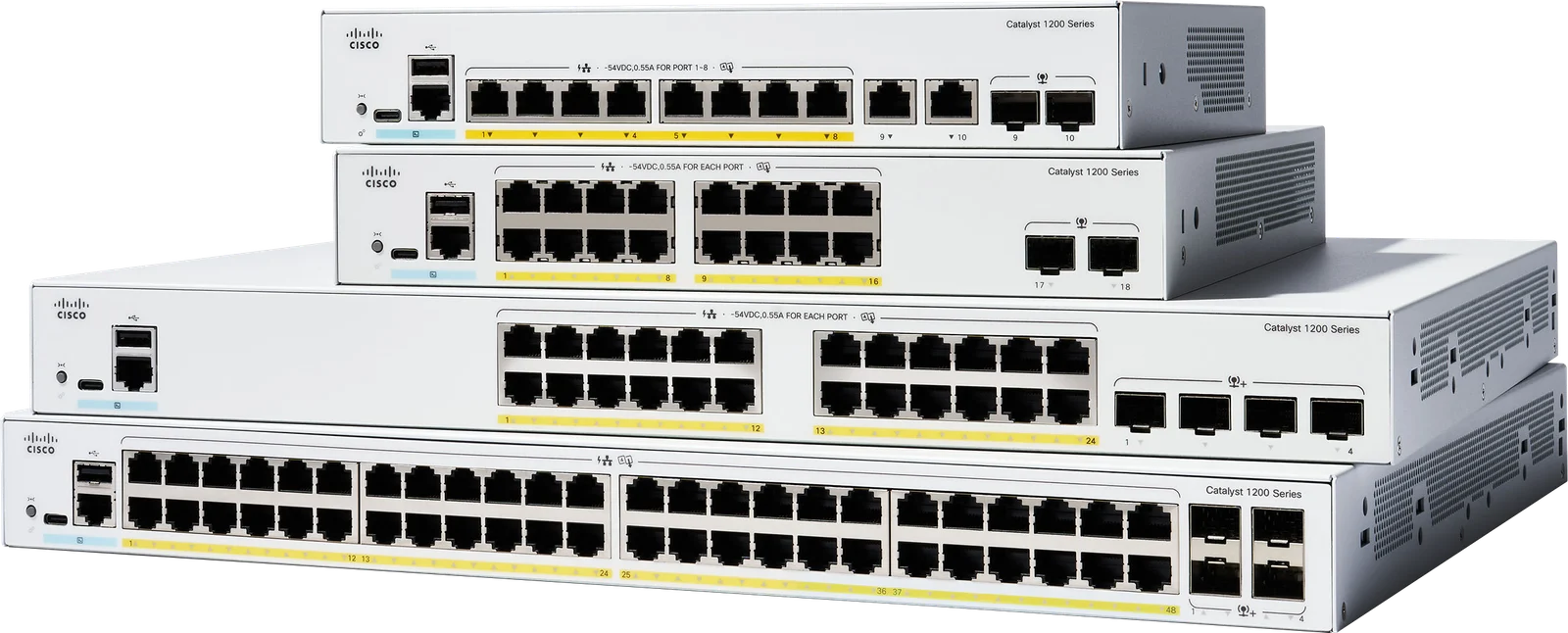
Brand: Cisco | Category: Network Switches
SKU: CISCO-C9300L-48T-4X-E-CATALYST-9300L-48-PORT | Part #: CISCO-C9300L-48T-4X-E-CATALYST-9300L-48-PORT
Contact for Pricing — Request a Quote
The Catalyst 9300L C9300L-48T-4X-E operates as a pure Layer 2 access switch with optional stateful routing capabilities through Cisco IOS XE, positioning it in the middle ground between simple managed switches and full Layer 3 fabric participants. While this model does not natively support VXLAN or EVPN overlays, its control plane via IOS XE allows for static routing, RIP, OSPF, and BGP—depending on licensing—making it suitable for traditional IP subnetting at the access tier rather than modern intent-based fabric deployments. This architectural distinction matters: the C9300L-48T-4X-E is engineered for enterprises transitioning from older access-layer hardware or consolidating branch and campus networks where dynamic fabric membership is not a requirement. Network engineers selecting this platform expect to manage routing at the aggregation or core layer, treating the 9300L as a high-density, reliable ingress point for thousands of users and devices.
Cisco's Catalyst 9300L line has earned a reputation in medium to large deployments for delivering performance without the complexity of full modular systems. The C9300L-48T-4X-E specifically provides 48 fixed Gigabit Ethernet downlink ports (10/100/1000 Mbps on RJ-45), four 10G SFP+ uplink ports, and a switching fabric of 176 Gbps with a forwarding rate of 130.95 million packets per second. That throughput is sufficient for access-layer aggregation in data centers running virtualized workloads or enterprises consolidating multiple smaller access switches into a single 1RU form factor. The internal UADP (Unified Access Data Plane) ASIC from Cisco handles packet processing with minimal latency, and the 32,000-entry MAC address table accommodates large broadcast domains without performance degradation—a critical consideration when deploying this hardware in heavily segmented enterprise networks.
Memory and onboard storage are modest but purposeful. The unit ships with 4 GB of DRAM and 1 GB of flash, sufficient to run Cisco IOS XE at scale with reasonable syslog buffering and packet capture capabilities for troubleshooting. Administrators familiar with Cisco platforms will recognize this as standard for access-layer hardware; the trade-off is that advanced packet analysis or local telemetry storage is best offloaded to external collectors rather than retained on the switch itself. The Cisco IOS XE operating system provides a consistent management experience across the broader 9300 family, meaning teams already operating Catalyst hardware elsewhere can apply existing automation, monitoring, and security policies to the C9300L-48T-4X-E without retraining. This consistency—combined with Cisco's extensive documentation and integrations with third-party management platforms—reduces time-to-productivity for data center and enterprise operations teams.
Stackability is a key operational advantage for large campus or multi-floor deployments. Up to eight C9300L units can form a single logical stack using StackWise-160 technology, presenting a unified management plane and sharing a collective 160 Gbps of stack bandwidth. For a multi-building enterprise or a dense data center with segregated logical networks, this allows centralized configuration and monitoring without the operational overhead of independent devices. The fixed internal power supply and low maximum power consumption of approximately 67 watts (this non-PoE variant draws no PoE injection current) make the unit economical to operate and straightforward to power via standard PDU outlets in standard cabinets. The operating temperature range of 0°C to 45°C is typical for enterprise-class switches and suits most controlled data center environments. Physical dimensions of 1RU (1.73 inches tall, 17.5 inches wide, 15.6 inches deep) ensure it fits comfortably in standard 19-inch racks alongside compute and storage hardware, a practical consideration that network engineers often verify early in procurement cycles.
Deployment scenarios for the part number CISCO-C9300L-48T-4X-E-CATALYST-9300L-48-PORT span from branch office consolidation to data center ToR (top-of-rack) placement in smaller environments. A network administrator tasked with replacing aging Catalyst 2960 or 3850 platforms will find this unit a natural upgrade, offering faster fabric throughput and modern management capabilities while maintaining the same Cisco operational patterns. Similarly, infrastructure teams building out new lab networks or preparing for enterprise-wide SD-WAN migrations often select this platform as a stable access-layer foundation. The absence of PoE is deliberate—this model targets wired infrastructure where PoE demand is low or handled by separate injectors, reducing cost and power envelope. The combination of Layer 2 performance, optional Layer 3 routing, stacking capability, and consistent IOS XE management makes the Catalyst 9300L-48T-4X-E a pragmatic choice for organizations seeking proven, vendor-supported hardware without overprovisioning advanced features they do not yet require.
Omnixon Global stocks the Catalyst 9300L C9300L-48T-4X-E as part of our comprehensive Cisco switching portfolio serving data centers, AI infrastructure labs, and enterprise networks across the GCC, Middle East, and Asia-Pacific regions. Our team in Dubai understands the specific operational requirements of regional deployments—from the redundancy expectations of hyperscale operators to the cost-consciousness of growing startups. We carry inventory, provide pre-deployment configuration support, and coordinate seamlessly with Cisco's regional technical team to ensure your implementation moves from quote to production without unnecessary delay. For bulk orders, managed network services integration, or technical clarification on how this platform fits your architecture, we invite you to submit an RFQ or contact our sales engineering team directly.
| Brand | Cisco |
| Category | Network Switches |
| SKU | CISCO-C9300L-48T-4X-E-CATALYST-9300L-48-PORT |
| Part Number | CISCO-C9300L-48T-4X-E-CATALYST-9300L-48-PORT |
| Condition | New |
| Form Factor | Fixed |
| Manufacturer Part Number | C9300L-48T-4X-E |
| Series | Cisco Catalyst 9300L |
| Form Factor | 1 Rack Unit (1RU), fixed configuration |
| Total Ports | 52 (48 downlink + 4 uplink) |
| Downlink Ports | 48 x 10/100/1000 Mbps Gigabit Ethernet (RJ-45) |
| Uplink Ports | 4 x 10G SFP+ |
| PoE Support | None (non-PoE model) |
| Switching Capacity | 176 Gbps |
| Forwarding Rate | 130.95 Mpps |
| Stacking Technology | StackWise-160 |
| Maximum Stack Members | 8 |
| Stack Bandwidth | 160 Gbps |
| DRAM | 4 GB |
| Flash Storage | 1 GB |
| Operating System | Cisco IOS XE |
| Software License Tier | Network Essentials |
| ASIC | Cisco UADP (Unified Access Data Plane) |
| MAC Address Table Size | 32,000 entries |
| IPv4 Routing Entries (TCAM) | 24,000 |
| IPv6 Routing Entries (TCAM) | 16,000 |
| Power Supply | Fixed internal power supply |
| Power Consumption (Maximum) | Approximately 67W (no PoE) |
| Input Voltage | 100–240V AC, 50–60 Hz |
| Operating Temperature | 0°C to 45°C (32°F to 113°F) |
| Dimensions (H x W x D) | 1.73 in x 17.5 in x 15.6 in (43.9 mm x 444.5 mm x 396.2 mm) |
The Catalyst 9300L C9300L-48T-4X-E 48-Port Switch is enterprise networking hardware for data-center, campus, and branch deployments. Common roles include core/distribution switching, server uplinks, top-of-rack fabric, and edge connectivity in mixed Cisco/Juniper/Arista environments.
Key specifications for the Catalyst 9300L C9300L-48T-4X-E 48-Port Switch: new condition; series Catalyst 9300L; ports 48x 1G RJ45; uplinks 4x 1/10G SFP+ (Fixed); software Network Essentials (E); form factor Fixed. Manufacturer part number CISCO-C9300L-48T-4X-E-CATALYST-9300L-48-PORT. For the full datasheet with electrical, environmental, and compliance details, contact our pre-sales engineering team.
The Catalyst 9300L C9300L-48T-4X-E 48-Port Switch interoperates with standard switching protocols (LACP, MLAG/VPC, 802.1Q, OSPF/BGP). For specific cross-vendor scenarios — Cisco-to-Arista MLAG peering, fabric integration with Cumulus/SONiC, or migration from legacy Catalyst — our network engineers map a compatibility plan as part of the RFQ.